Table of Contents
The real cost of paper (and what doesn’t show up in the print quote)
When a couple asks me how much they’re going to spend on invitations, here’s what I tell them first: the per-unit price from the printer is not the final price. It never is. And knowing that upfront saves you more than one unpleasant surprise.
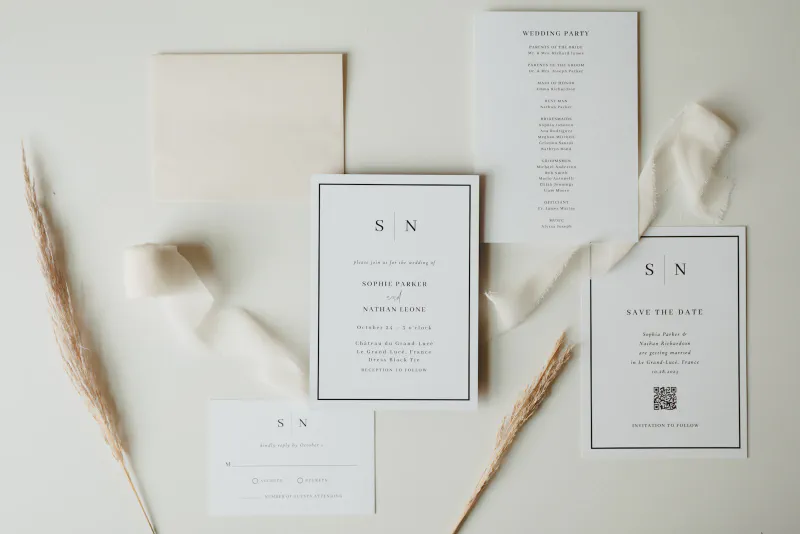
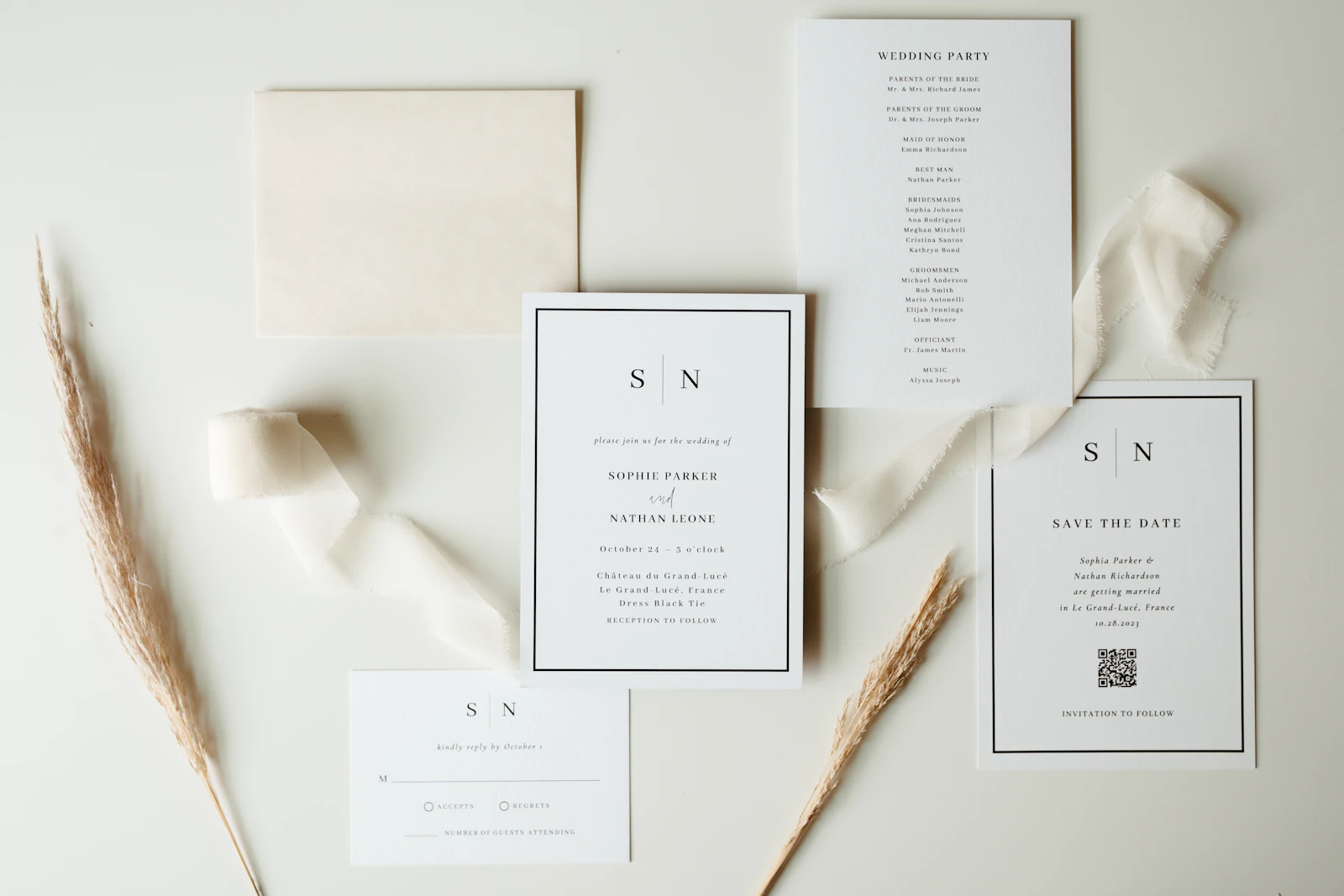
The typical range runs between 3 and 8€ per invitation, but that number depends on so many decisions that it’s almost meaningless without context. Textured paper costs more than standard matte. Dry embossing can double the base price. Gold foil adds another considerable premium. And lined envelopes — the kind that turn out beautifully and that the bride’s grandmother will keep in a drawer for years — have their own added cost.
For a wedding with 100 guests (many invitations go to couples, so you’re usually looking at 60–70 units), design and printing can easily land somewhere between 200 and 560€ just for paper. Before you’ve added anything else.
The hidden-cost trap
Here’s what nobody tells you at the start: postage and envelopes are completely separate. A standard stamp in Spain runs around 0.90€. If you’re sending 65 letters and you want the peace of mind of knowing who received theirs, you’re already looking at another 60–70€ just in stamps. Envelopes, depending on whether they’re standard or lined, add another 20–40€. None of these amounts are huge on their own, but together they push the total well above what you were expecting when you first sat down with a quote.
And then there are the typos. I know couples who’ve had to reprint 20 to 30% of their invitations — wrong ceremony time, misspelled surname, an address that changed. The printer charges you either way, and a partial reprint often works out proportionally more expensive than the original order, because there are fixed setup costs that apply to any print run, large or small.
Time factors into the budget too, even though it never appears on any invoice. Quality printers typically work on 3 to 6 week lead times from the moment you approve the color proof. Rush jobs cost extra. Corrections after seeing the proof — and there almost always are some — restart the clock.
What changes with digital invitations
The biggest shift isn’t cost — it’s the concept. A well-made digital invitation isn’t a WhatsApp image or a PDF sent by email. It’s a URL, a web page, that your guests open on their phones and find all the wedding information organized: when, where, how to get there, parking, what happens with kids. And from which they can RSVP without sending you a message that gets buried in the rest of the conversation.
The direct savings are clear:
- Zero spending on paper, printing, or envelopes
- No stamps: you share via WhatsApp, email, or whatever you use
- No reprints if anything changes. Edit it and everyone who opens the link sees the updated version
- No printer lead times. You could be sharing in hours, not weeks
But the argument that actually convinces me isn’t the money. It’s the flexibility. I’ve seen weddings where the date had to change three weeks out because of a problem with the venue. With paper, that was a logistical nightmare. With digital, it was a text change and done. No extra cost, no scramble to resend everything.
(That said — I’ve also seen older guests receive a link and not quite know what to do with it. Not an unsolvable problem, but worth keeping in mind if your list has a lot of guests from that generation.)
Paper vs. digital: the direct breakdown
| What you’re paying for | Paper (60–70 invitations) | Digital (Invitatis) |
|---|---|---|
| Design & printing | 200–560€ depending on finishes | Free while you design and test |
| Postage & envelopes | 80–110€ | Not applicable |
| Reprints for errors | Variable. Could be nothing — or could be a real headache | Doesn’t exist. You edit directly |
| Publishing / activation | Already baked into the total above | 75€, one-time payment, everything included |
| Time to send | 3–6 weeks from proof approval | Hours, if you want |
| Changes after sending | Reprint, with the corresponding cost | No extra cost, ever |
| Emotional value | Gets saved, framed, stuck on grandma’s fridge | Everyone can access it whenever, from wherever |
For 100 guests with Invitatis, the cost per person comes to 0.75€. For 200, half that. The price doesn’t scale with guest count, so the math always works in your favor. If you want to see exactly what that one-time payment includes (and what happens if you end up not publishing), it’s all laid out on the wedding invitation price page.
An honest note: Invitatis doesn’t replace the physical memory of holding a beautiful invitation in your hands. If that object — the texture of the paper, the envelope, keeping it as a keepsake — has real value for you, it does. I’m not saying it’s not worth it. I’m saying think carefully about who you’re really doing it for.
When to choose paper, when to choose digital: my unfiltered take
There’s no universal answer, but if you ask me directly, this is what I think:
Paper is worth it when the guest list is small (under 40 or 50 people), when the design is a central part of your wedding aesthetic and you want the invitation to be an object in itself, or when you know your guests will genuinely appreciate it — by generation, by aesthetic sensibility, or simply because it’s your closest family.
Digital makes more sense when the list is long, when you have guests outside the country, when the budget is tight and you’d rather spend it elsewhere, or when the logistics might still change. Also when you simply prefer not to manage the whole printing process and everything it entails.
And plenty of couples do both: paper for the 20 or 30 closest, digital for everyone else. It’s neither complicated nor contradictory. It’s just practical.
If you already know which format you want but aren’t sure about timing, the post on when to send wedding invitations gives you the dates with enough buffer so you don’t end up cutting it close.
Curious about what your digital invitation might look like before committing to anything? You can design and test it for free on Invitatis — no commitment until you decide to publish. When you’re ready to explore, all the design examples and options are on the digital wedding invitations page.